

At Great American Spaces, we offer both shiplap and tongue-and-groove products for interior walls and ceilings. Both add texture and character, but they connect differently and offer different face profiles and fastening methods.
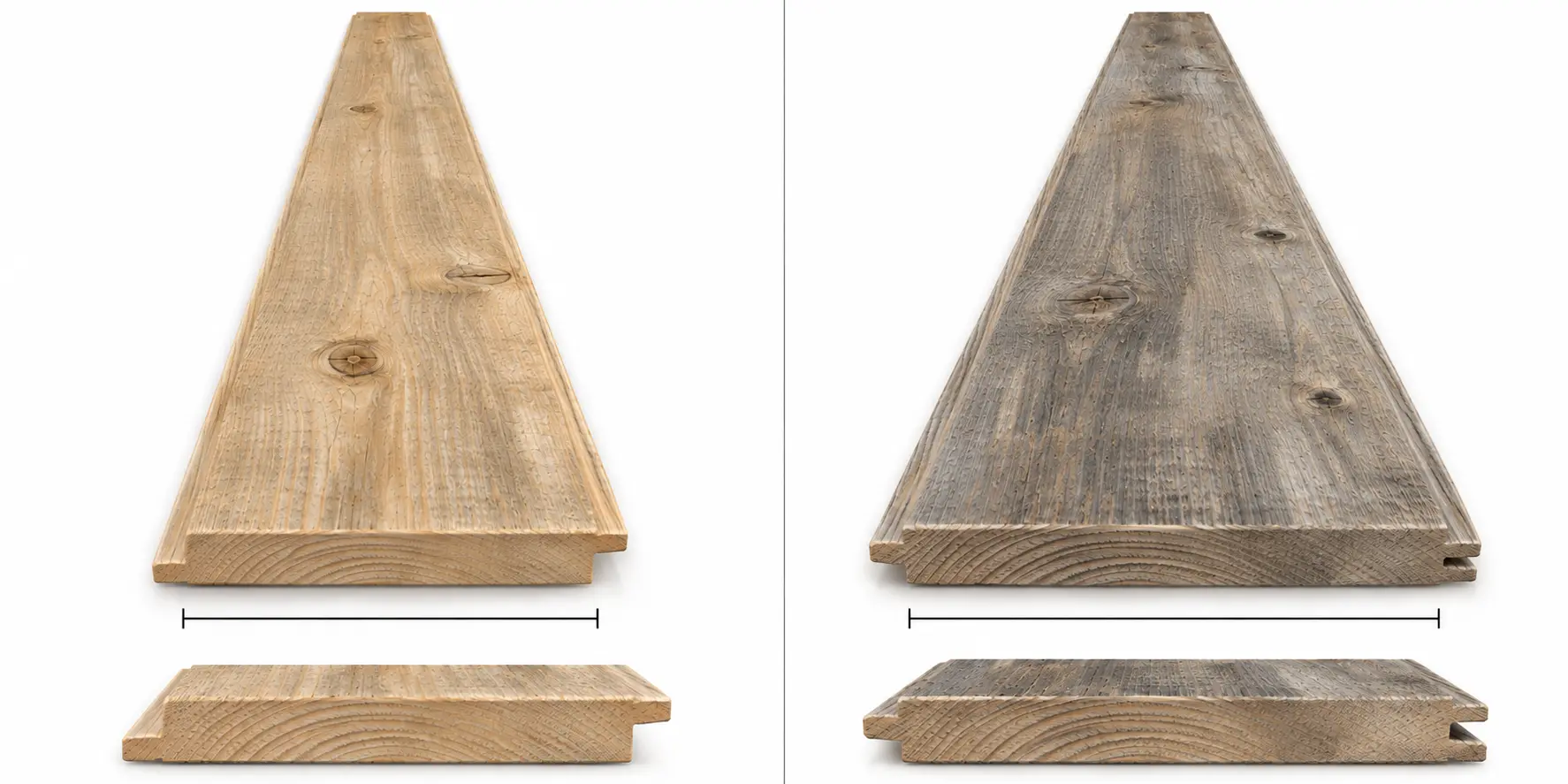
Our ShipLap boards overlap at stepped edges to create a visible reveal. Our tongue-and-groove products fit together with a tongue and groove and are available in profiles such as smooth, V-groove, and nickel gap. The right choice depends on the look you want and the requirements of your project.
What Is the Difference Between Shiplap and Tongue and Groove?
The main difference is how the boards join:
-
Tongue and groove: A projecting tongue on one board fits
into a groove on the next. Depending on the product and installation,
fasteners can be concealed in the joint.

-
Shiplap: Stepped edges overlap to create a reveal between
boards. Our ShipLap installation uses face nails on the first and last
boards and nails through the flange on other courses. Follow the
product-specific guide for fastening details.

| Feature | Tongue and groove | Shiplap |
|---|---|---|
| How boards connect | A tongue fits into a groove (interlocking mechanism) | Stepped edges overlap |
| Appearance | Can be smooth, V-grooved, or have a narrow gap | Visible horizontal reveals |
| Fastening | Hidden fasteners can be concealed in the joint | Face-nailing is used as directed in the installation guide |
| Common interior uses | Walls and ceilings | Walls |
Profiles vary between products, so we recommend reviewing the product page and installation guide before ordering.
A Note on the Term “Shiplap”
“Shiplap” is often used as a catch-all term for interior wood planking or paneling, even when the boards aren’t technically shiplap. People may use it to describe tongue-and-groove planks or wainscoting, too. When comparing products, look at the actual board profile and how it installs, not just the name.
Our ShipLap, Smooth Pine, and Smooth Primed MDF pages show the profiles and specifications for each product.
What Do Shiplap and Tongue and Groove Look Like?
Both can add texture and dimension to a room. Our ShipLap boards create visible lines where the boards overlap. Our tongue-and-groove products offer different face profiles, including smooth, V-groove, and nickel gap.
Explore the profiles on our ShipLap, Smooth Pine, and Smooth Primed MDF product pages. Check the specifications to confirm the profile and finish for the product you’re considering.
Which Should I Choose for My Project?
As a starting point:
- Choose tongue and groove if you want a smooth face, V-groove, or nickel-gap profile, with the option of concealed fasteners. For ceiling applications or larger projects, our Tongue and Groove collections are preferred due to the interlocking mechanism and higher square footage covered per board.
- Choose ShipLap if you want overlapping boards, visible horizontal reveals, or darker colors.
- For ceilings, tongue and groove collections are preferred over shiplap due to ease of installation. It is more difficult to hold ShipLap boards in place on the ceiling due to the lack of an interlocking mechanism (found in T&G boards like Easy BarnWood).
- For larger projects, tongue and groove products like Easy BarnWood offer more coverage per 16 ft board than our ShipLap. A 16 foot Easy BarnWood board offers 9" square feet of coverage while a 16 foot ShipLap board can cover 6" square feet.
Before ordering, compare the product’s profile, dimensions, material, coverage per board, fastening requirements, and approved applications. Browse our product pages and installation resources to find details for the product you’re considering.
Are Shiplap Fasteners Visible?
Our ShipLap installation guide calls for face-nailing the first and last boards and nailing through the flange on the other courses. The guide also says not to nail through overlapping pieces. Follow the complete ShipLap installation guide for placement and fastening details.
With tongue-and-groove boards, fasteners can be placed through the joint to help conceal them. The fastening method varies by product and profile, so use the instructions for the exact boards you’re installing.
Is Shiplap or Tongue and Groove Easier to Install?
The best fit depends on the product, your project, and your experience. Shiplap boards are positioned one at a time. Tongue-and-groove boards need to be aligned so each tongue fits into the next board’s groove. For either style, a straight, level first course and careful measuring are important. For ceiling installations, tongue and groove is preferred over shiplap due to ease of installation. It is more difficult to hold ShipLap boards in place on the ceiling due to gravity and the lack of an interlocking mechanism (found in T&G boards like Easy BarnWood).
Plan for cuts around corners, outlets, trim, lights, and vents. Follow the product’s directions for surface preparation, fasteners, spacing, and finishing. You can find our product-specific guides on the Dealer & Designer Resources page.
Do Shiplap and Tongue-and-Groove Boards Expand and Contract?
Wood changes size as humidity changes. Follow the instructions for your product to allow for movement:
- Acclimate the boards as directed.
- Leave the required expansion gap around the perimeter.
- Don’t force boards tightly together unless the instructions call for it.
- Use the specified fasteners and installation method.
For example, our ShipLap guide says to store boards indoors and acclimate them in the installation space for at least 72 hours. It also specifies the expansion gaps for that product. Always refer to the guide for the product you’re installing.
Can I Use Shiplap or Tongue and Groove on an Interior Wall?
Our shiplap and tongue-and-groove products are designed for interior wall and ceiling applications, but the installation requirements vary by product. Check the product page and installation guide to confirm it’s suitable for your project and to understand how to install it.
Decorative boards don’t automatically replace drywall for fire, sound, insulation, or building-code requirements. Check local requirements and the manufacturer’s instructions before beginning your project.
Can Shiplap or Tongue and Groove Be Installed on a Ceiling?
Some products are suitable for ceilings. Before installation, confirm that your chosen product is approved for overhead use and follow its fastening instructions, including where to fasten and what framing or support is required.
Plan how the boards will end at walls and fit around lights, vents, and beams. Our ShipLap installation guide includes instructions for that product’s wall and ceiling installation. Don’t assume the same directions apply to other products.
